


CRP - Coronary Heart Disease TestFind Out Your Risk for Heart Disease The CRP test measures the level of inflammation you have in your arteries and is a simple test that can detect heart disease. Heart Disease is now the number one killer of women partly because the symptoms are ignored, the CRP test is a good indicator of your heart health. Using this home CRP test, your blood sample is sent to a CLIA certified lab and your results are then available on a secure website.
Temporarily Out of Stock
$0.00 each

SKU #: H-CRP
CORONARY HEART DISEASEC-Reactive Protein TestsCoronary Heart Disease can be detected early with C-Reactive Protein Tests. C-reactive protein (CRP) is a substance produced by the liver and its levels increase during periods of inflammation. Though not condition specific, inflammation is a significant indicator of health problems such as coronary heart disease. Early detection of coronary heart disease is possible with a C-Reactive Protein Test. 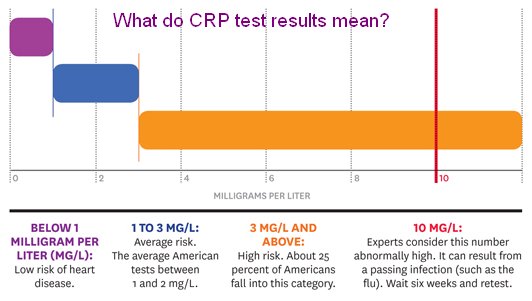
The high sensitivity C-Reactive Protein Test combines the convenience of a home sample collection with the accuracy of a certified clinical laboratory determination. The major factors that promote coronary heart disease - cigarette smoking, high blood pressure, atherosclerosis, and high blood sugar - are well established. These risk factors give rise to a variety of noxious stimuli that cause the release of chemicals and the activation of cells involved in the inflammatory process. These events are thought to contribute not only to the formation of plaque but may also contribute to its disruption resulting in the formation of a blood clot. Thus, virtually every step in the development of plaque is believed to involve substances involved in the inflammatory response and cells that are characteristic of inflammation. 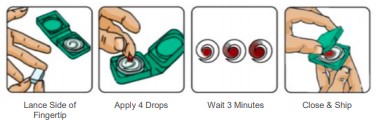 Read complete test instructions CRP Test Instructions View a sample lab report CRP Test Lab Results 1. Complete Test Requisition and consent form. 2. Take Blood Collection Device from foil pouch and affix barcode label to the top/lid of green device so it will show when closed. 3. Wash hands with warm water and dry thoroughly. Clean with alcohol pad. 4. Remove cap from lancet and hold lancet steady, press down on side of fingertip pad 5. Drip blood from fingertip to fill the middle circle of collection device - about 4 drops 6. Allow the blood to soak into the device for about 3 minutes 7. After blood is absorbed, close the green device firmly by folding over the top. Make sure the latches are secure and your barcode label shows on lid when it is closed. 8. Place Test Requisition Form and blood collection device in return mailing envelope within 24 hours of collection and mail to lab 9. Allow 5-7 days for delivery of your sample to the lab and an additional 3-5 days for processing. Your results will be available online at on https://www.dbslabportal.com/. If you are unable to retrieve your test results, you must call the lab directly at 816-425-1690 between 9am-4pm CST. Q: What will show on my test results? A: A number showing the mg/L or milligrams per liter which represents the presence of the c-reactive protein in your blood. |

Accurate Tests...since 1996 Fast & Discreet Shipping


